AI Music Rights in 2026: What You Can Actually Own, Release, Monetize, and Register

AI Music Rights in 2026 — ownership, monetization, and distribution explained.
Making AI music is easy now. Understanding the rights is not.
That is why so many artists, producers, and creators get tripped up. A track can sound finished, polished, and ready for release — and still come with the wrong rights for what you want to do next.
In 2026, the real question is not “Which AI music platform sounds best?”
The real question is: what can you actually do with the song after it is generated?
AI Music Platforms Rights Comparison 2026
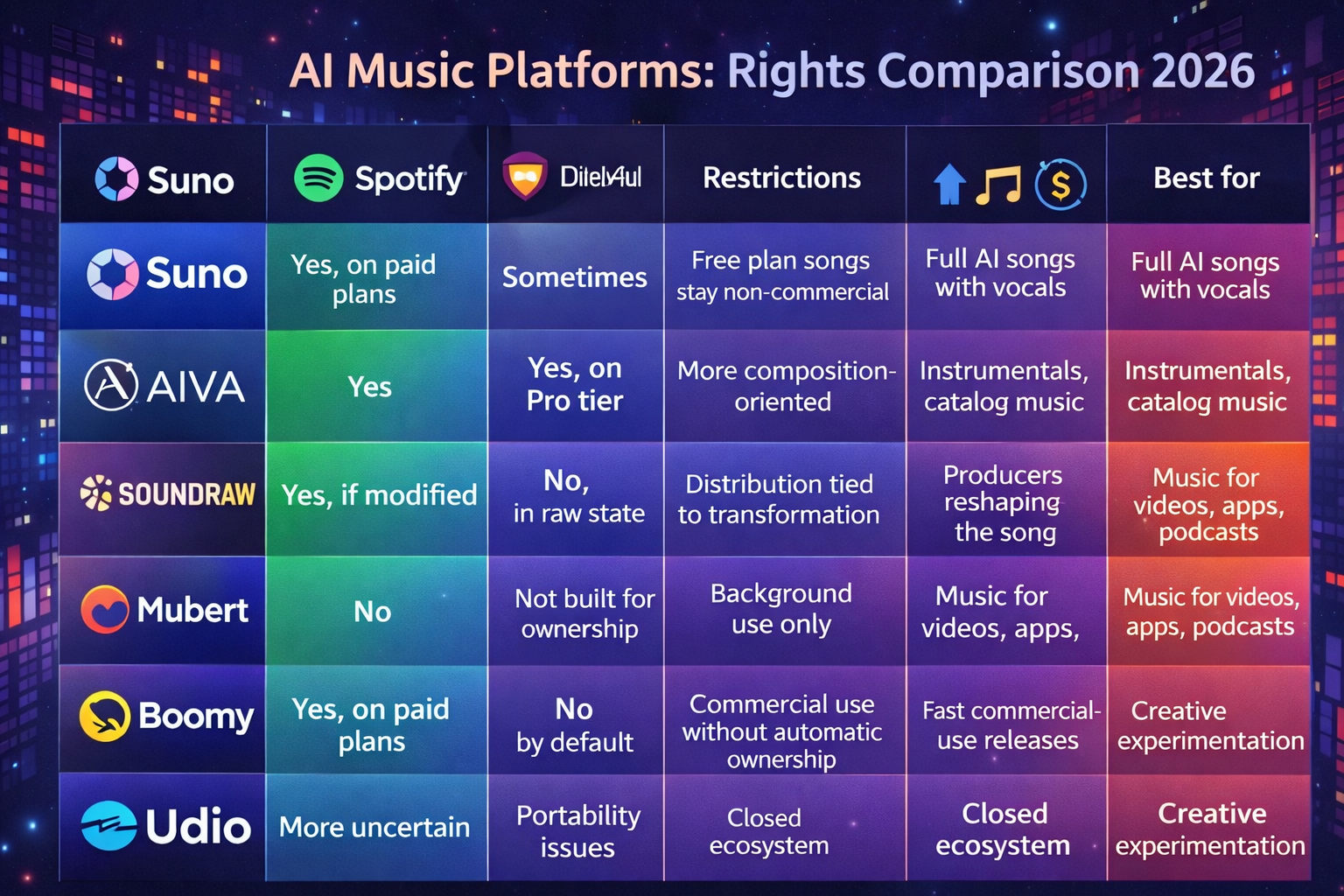
Comparison chart showing ownership, commercial rights and distribution limitations across major AI music platforms.
The three things people keep mixing up
Most confusion around AI music comes from treating three different questions like they are the same:
- Can I release it? Meaning: can I upload it to Spotify, Apple Music, or YouTube?
- Do I own it? Meaning: do I have actual ownership, or just permission to use it commercially?
- Can I register it? Meaning: do I have a strong enough authorship claim to put it in my name?
Those are not the same thing.
A platform can let you monetize a track without giving you full ownership. It can give you commercial rights without giving you a strong copyright position. It can let you distribute the song but still block things like Content ID or require meaningful modification before release.
That is the whole game.
Quick comparison: who is best for what?
| Platform | Best for | Can you release it? | Can you really own it? | Main catch |
|---|---|---|---|---|
| Suno | Full AI songs with vocals | Yes, on paid plans | Strong rights to use and monetize, but not a copyright guarantee | Free-plan songs are non-commercial and do not become commercial later |
| AIVA | Instrumentals, catalog music, rights-first workflows | Yes | Strongest ownership path here | Better for composition-driven work than instant vocal singles |
| Soundraw | Producers who will transform the track | Yes, if modified | Not clean full ownership of the original generated song | No straight release of the raw track, no Content ID |
| Mubert | Background music for videos, podcasts, apps, games | No, not for normal streaming releases | Not built as an artist-release ownership play | Great for sync-style use, weak for singles |
| Boomy | Fast commercial workflow | Yes, on paid plans | No, not by default | Boomy keeps default copyright while paid users get commercial rights |
| Udio | Creative experimentation | More uncertain strategically | Portability is the bigger issue | Walled-garden direction makes long-term release planning weaker |
Suno: the easiest commercial release path, with one big legal limit
Suno is still one of the most practical tools for people who want complete AI songs and a relatively simple path to distribution.
The important part is this: on paid plans, Suno gives users commercial use rights for songs created during the paid subscription. Those songs can be distributed through outside distributors, and those rights stay with the user even after the subscription ends.
That makes Suno one of the strongest choices for creators who want to move from prompt to Spotify without too much friction.
But there is a catch that matters a lot: commercial rights are not the same as guaranteed copyright ownership. Suno’s own legal framing makes that distinction clear. You may have the right to use, release, and monetize the output without automatically having a bulletproof copyright claim in the final work.
Another detail that people miss: free-plan songs are non-commercial, and they do not become commercial retroactively just because you upgrade later. That one point alone confuses a huge number of users.
Bottom line: Suno is one of the best platforms for commercially releasing full AI songs, but it is not a magic “I fully own this forever in every legal sense” button.
AIVA: the clearest ownership-first option
AIVA is not the trendiest name in AI music, but it stays important for one reason: its rights structure is much easier to understand than most of the market.
That matters because creators who care about publishing, licensing, sync, or long-term catalog value usually do not want vague rights language. They want something cleaner.
AIVA’s stronger paid tier is the closest thing here to a straightforward ownership play. It is especially attractive for instrumental music, cinematic work, library music, and composer-led workflows where rights control matters more than hype.
There is also a practical reason AIVA stands out: it is one of the few options that feels built for people thinking beyond a one-off upload. It feels more like infrastructure than a novelty generator.
Bottom line: if the priority is cleaner copyright control rather than the fastest viral-style vocal output, AIVA is one of the strongest choices in the entire field.
Soundraw: strong for transformation, weak for one-click ownership
Soundraw only makes full sense when you stop treating it like a finished-song machine.
It works better as raw material.
That is the key mental model. Soundraw is useful when you want a base that you will actively reshape through vocals, remixing, arrangement changes, instrumental additions, and production work. Its structure is built around transformation, not passive export.
That is why one detail matters so much: distribution is tied to modification. The final version needs to sound clearly different from the original downloaded track. On top of that, registering the raw material in Content ID is not part of the appeal here.
There is also a rights nuance that serious users care about: Soundraw’s model is not “you own the entire original AI song outright.” The platform keeps meaningful rights in the original generated work, while your edits and additions strengthen your claim over what you turn it into.
Bottom line: Soundraw is great for producers who actually produce. It is much less attractive for anyone hoping to click once and walk away with a cleanly ownable finished song.
Mubert: useful, but for the wrong job if you are thinking like an artist
Mubert is one of the easiest platforms to misunderstand.
It is often treated like an AI song tool when it makes much more sense as a background music tool. Its natural use case is music under something else: videos, podcasts, apps, games, commercial content, branded pieces.
That means it can be very useful. It just is not aimed at the same goal as Suno or even Boomy.
The mistake happens when creators try to use Mubert like a normal release platform for singles. That is not where it shines, and it is not where its rights model is strongest.
Bottom line: for soundtrack-style use, Mubert is solid. For putting out artist singles on streaming platforms, it is the wrong tool.
Boomy: commercially usable, but ownership is where people get fooled
Boomy remains attractive because it feels easy, fast, and built for immediate output.
And to be fair, it can work commercially. Paid users can get commercial rights for downloaded songs and releases, and that can fit a real distribution workflow.
But the critical detail is the one people skip: default copyright stays with Boomy.
That means Boomy is not a clean ownership-first platform. It is a commercial-use platform with a rights caveat attached. That distinction matters more than the marketing language around speed and access.
Bottom line: Boomy can be part of a commercial workflow, but “I can use this” is not the same thing as “this is fully mine.”
Udio: creatively interesting, strategically weaker
Udio is not really the story because of quality anymore. The bigger issue is distribution logic.
When a platform starts moving toward a more controlled ecosystem, independent artists should pay attention. Portability matters. Open release pipelines matter. The ability to treat a song like a normal asset matters.
That is why Udio feels riskier as a long-term release foundation. It may still be creatively valuable. But from a business and rights perspective, the direction is harder to trust if your goal is broad, open distribution.
Bottom line: good for experimentation, weaker for anyone building a portable release strategy.
DistroKid, Spotify, and YouTube: they are not solving your rights problem for you
This is where a lot of creators get blindsided.
DistroKid may allow AI-generated music, but that does not mean it is clearing the rights for you. It is not your legal shield. If you upload a release, you are the one representing that you hold the necessary rights.
Spotify and YouTube are also not the old version of naive platforms anymore. Their concern is less “AI exists” and more “is this deceptive, low-value, spammy, cloned, or built on rights you do not actually control?”
That changes the real compliance question.
It is no longer just: “Can I upload AI music?”
It is: can I upload this specific track, from this specific platform, under these specific rights, without lying about what I control?
What creators still get wrong in 2026
The biggest mistake is thinking the product is the song.
It is not.
The product is the rights bundle attached to the song.
That bundle may include commercial permission. It may include ownership. It may block Content ID. It may require modification first. It may allow monetization while leaving your copyright position weak. It may let you use the file without really giving you a strong catalog asset.
That is why two AI tracks can sound equally polished and still have completely different business value.
The real best picks
- Best for full-song commercial release: Suno paid plans
- Best for cleaner ownership and catalog logic: AIVA Pro
- Best for producers who will heavily transform the material: Soundraw
- Best for background music and sync-style use: Mubert
- Fast commercial option with a serious ownership caveat: Boomy paid plans
- Weakest strategic fit for open distribution right now: Udio
Final word
In 2026, the smartest creators are not just asking which AI music tool sounds best.
They are asking the more useful question:
What exactly am I allowed to do with this song once it leaves the prompt box?