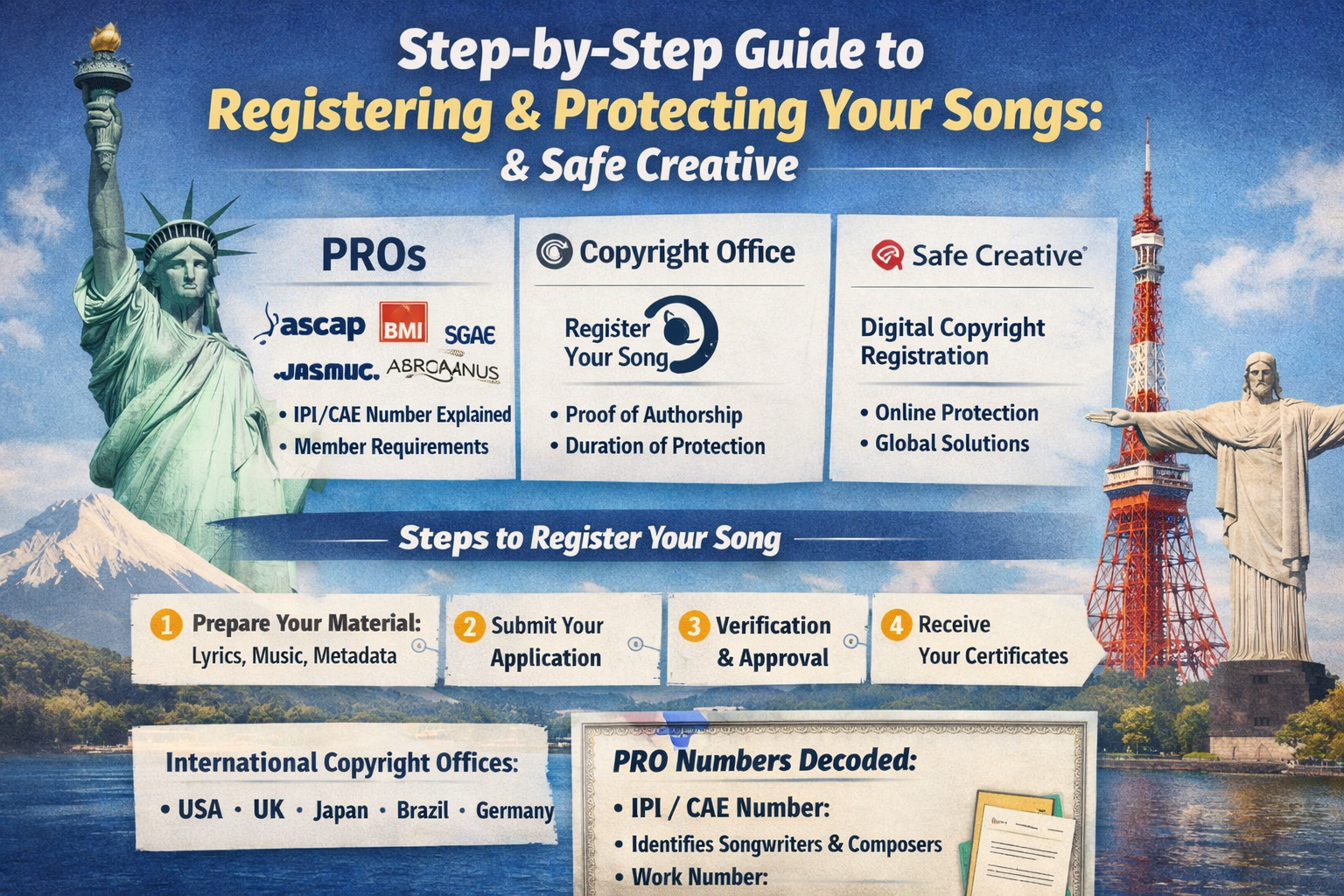
If you make music and want to protect it properly, the first thing to understand is this: registering a song is not one single task.
That is where most of the confusion starts. A lot of people throw copyright, public registration, ASCAP, BMI, PRS, Safe Creative, ISRC, and IPI into the same conversation as if they all did the same job. They do not. And when you do not separate those layers, it becomes very easy to expect a PRO to work like an official copyright office, or to treat a private certificate as if it replaced royalty administration.
The practical way to think about this is to separate the real functions involved: proving authorship, creating an official public record, administering and collecting royalties, and identifying people, compositions, and recordings correctly inside the music business. Once that is clear, the whole system makes a lot more sense.
Your song already exists as a right, but that does not mean the rest is handled
In most countries, a song does not start existing the day you file paperwork. The work is already protected once it exists as an original creation and is fixed in some form.
That does not mean you can ignore everything else. One thing is having the right. Another is being able to prove it well, organize it well, and collect money from it properly once the song starts moving. That is where public copyright registration, PROs, industry identifiers, and sometimes a private evidence layer come in.
What each layer actually does
1. Public copyright registration
A public copyright registration creates an official record of the work. In practice, it can make your position stronger if there is a dispute, an assignment, an inheritance issue, a conflict over authorship, or any situation where you need formal proof of date and ownership.
It does not collect royalties. It does not replace a PRO. It does not pay you because your song was played on radio, performed live, or streamed online. Its main role is legal and evidential.
2. PRO or collecting society
A PRO is not a public copyright office. A PRO exists to administer repertoire, license certain uses, and collect royalties for public performance and other rights depending on the territory.
That is the role of organizations such as ASCAP, BMI, PRS, JASRAC, and, in Brazil, the associations that work within the ECAD system. In simple terms, a public registration helps you prove and formalize the work. A PRO helps you administer it and get paid.
3. Industry identifiers
This is where the codes come in: IPI / CAE, ISWC, ISRC, and sometimes UPC / EAN.
These do not replace copyright and they do not register a song with the government by themselves. What they do is identify the right people, compositions, recordings, and releases inside the music ecosystem.
4. Private evidence tools
This is where something like Safe Creative fits. It is not a public office and it is not a PRO. Its real use is as an extra technical layer for timestamping authorship, files, dates, or parts of the creative process.
That can be useful, but it works best as a complement, not a substitute for the rest.
The difference between a song and a recording
This matters because a lot of people mix both things from the very beginning.
A musical work is the composition itself: melody, harmony, lyrics, structure, and writing. A sound recording is the master, the phonogram, the specific recorded version you eventually distribute.
If you wrote a song and then recorded it, you are dealing with two different layers: the composition and the recording. That distinction matters because public registration can treat them differently, PROs mainly manage the composition side, and digital distribution works heavily on the recording side.
What each number means
IPI or CAE
An IPI identifies a person or entity inside the international collecting society system. It tells the system who each writer, composer, or publisher actually is when works are registered and money is distributed.
What matters is this: an IPI identifies the person or entity. It does not identify the song and it does not identify the recording.
ISWC
An ISWC identifies the musical composition. It is not the code for the master and it is not the release code used by your distributor. It belongs to the song as a written work.
ISRC
An ISRC identifies the sound recording or music video. This is the code tied to the master. If you release music through a distributor, this is usually the code attached to that specific recording.
UPC or EAN
A UPC or EAN does not identify the song or the individual recording. It identifies the commercial release: a single, EP, album, or bundle.
The simple version is this:
- IPI/CAE = who the person or entity is
- ISWC = which composition it is
- ISRC = which recording it is
- UPC/EAN = which release it belongs to
What you should have ready before filing anything
If this part is messy, everything gets harder later. Before going near a public registration or a PRO, it helps to have these details ready:
- the exact title of the work
- the legal names of all writers
- artist names, if relevant
- the split percentages
- who wrote the music and who wrote the lyrics
- whether there is a publisher
- whether a final master already exists
- the ISRC of the master, if you already have it
- banking and tax details, if you are joining a PRO
- personal identification
- the actual material of the work: lyrics, score, audio, or both, depending on the process
One of the most common mistakes is trying to register works before the splits are settled. If that foundation is wrong, the same confusion carries into repertoire, payments, and credits.
PRO membership requirements, country by country
Spain: SGAE
SGAE is built for authors, composers, publishers, heirs, and other roles within the repertoire it manages. It has a one-time online joining fee, and once you are inside, registering works in its system is free.
In practice, entry usually involves:
- full personal details
- identity documentation
- a work or repertoire that fits the types it manages
- payment of the joining fee
- if you are underage, intervention from a parent or legal guardian
Once you are in, you register works with title, rightsholders, percentages, and repertoire metadata.
United States: ASCAP
ASCAP is a fairly accessible route for writers. Joining as a writer is straightforward if you already have at least one work available to the public.
The practical points are:
- joining as a writer is free
- each group member has to join individually if they want to be paid correctly
- if you also want to operate as a publisher, the structure becomes more formal and tax details matter more
ASCAP is not a public copyright registry. It is a royalty and licensing organization.
United States: BMI
BMI is also very accessible for songwriters and composers. Joining as a writer is free, there are no yearly dues, and it is built for people who already have at least one composition being performed or likely to be performed soon.
It helps to know this:
- writer and publisher are not the same thing
- you can join first as a writer and decide later whether you want your own publishing entity
- if you are under 18, the process involves additional banking requirements
- the standard writer/composer agreement starts with a fixed initial term
If you want your own publisher account with BMI, that is where different fees and business-entity requirements come into play.
United Kingdom: PRS and MCPS
PRS covers public performance and communication royalties. MCPS sits on the mechanical side. Sometimes you need one. Sometimes both make sense.
For writers, PRS tends to require:
- that you own copyright in musical works
- valid identification
- a payment method
- and a realistic expectation that the music is already being used publicly or will be used soon
If your music is also going to be mechanically reproduced or exploited, adding MCPS can make sense. For publishers, the entry requirements are much heavier and involve minimum catalogue, evidence of exploitation, and a real publishing structure.
Japan: JASRAC
JASRAC is much more demanding from a territorial and operational point of view. It is not the natural route for someone who simply wants to “be in Japan” from abroad.
In practical terms, things that usually matter are:
- residency in Japan or a real center of activity there
- a Japanese bank account
- the ability to operate in Japanese or through a suitable contact
- evidence that the works are being used or will be used in Japan
JASRAC makes sense when your operation and exploitation genuinely run through Japan. Not as a decorative membership.
Brazil: association + ECAD system
Brazil works differently. Public performance collection is centralized through ECAD, but rightsholders usually enter the system through an association.
In practice, that means:
- joining a valid association
- registering your personal and artistic details
- submitting works and phonograms
- keeping your repertoire updated
It is less “I join ECAD directly” and more “I join an association that operates inside the ECAD structure.”
The right order to handle this
Step 1: settle the splits before release
Do not register anything with vague percentages. You need to know who wrote what and what share belongs to each person.
Step 2: separate the composition from the recording
Be clear about what you are registering and what you are administering. If you are creating an official record of the work, make sure you are dealing with the composition as a work. If a master already exists, treat that as its own layer.
Step 3: decide whether you need an official public record
Not every case requires immediate public registration, but if there is commercial risk, multiple writers, licensing potential, or a need for stronger legal backing, it often makes a lot of sense.
Step 4: join one main PRO
You do not need ten society memberships at once. Usually, the sensible move is to join the main society that matches your territory or your real operating base.
Step 5: register the work properly inside the PRO
This is where IPI numbers, shares, co-writers, publishers, and repertoire data matter. This step is what organizes the royalty and administration side.
Step 6: identify the master properly
If the recording is finished, make sure the master is properly identified inside the distribution chain, usually through its ISRC.
Step 7: add private evidence only if it gives you real value
That can make sense if you want a technical trail for drafts, process, deliveries, or timestamped files. But it should not replace the important layers.
Country by country: where to look first
- Spain: public copyright registration plus SGAE
- United States: U.S. Copyright Office plus ASCAP or BMI
- United Kingdom: no general public copyright registry, but PRS and MCPS on the management side
- Brazil: public registration through the National Library and royalty administration through the ECAD ecosystem
- Japan: automatic copyright protection plus JASRAC on the management side
- Mexico: INDAUTOR for public registration
- Colombia: DNDA for public registration
- Argentina: DNDA for public registration
The global answer, without the marketing
There is no magic platform that solves official public proof, international royalty administration, repertoire identification, master identification, and private evidence all at once.
What does exist is a smart global structure:
- copyright from creation
- public registration when it makes sense for proof or business
- one well-chosen main PRO
- correct use of IPI, ISWC, and ISRC
- clean splits and contracts
- private evidence only if it adds real value
That is what actually protects a song in a serious way.
Conclusion
The real question is not only how to register a song. The real question is how to leave it properly protected, properly documented, and properly prepared to get paid.
That is the difference between simply uploading music and building a catalogue.
And that is also the difference between moving like a hobbyist and moving like someone who already understands that a song is not only art. It is also an asset.
At se7en beatlab, we work on production, mixing, catalogue structure, and decisions that help music not only sound better, but also move, license, and collect more cleanly.