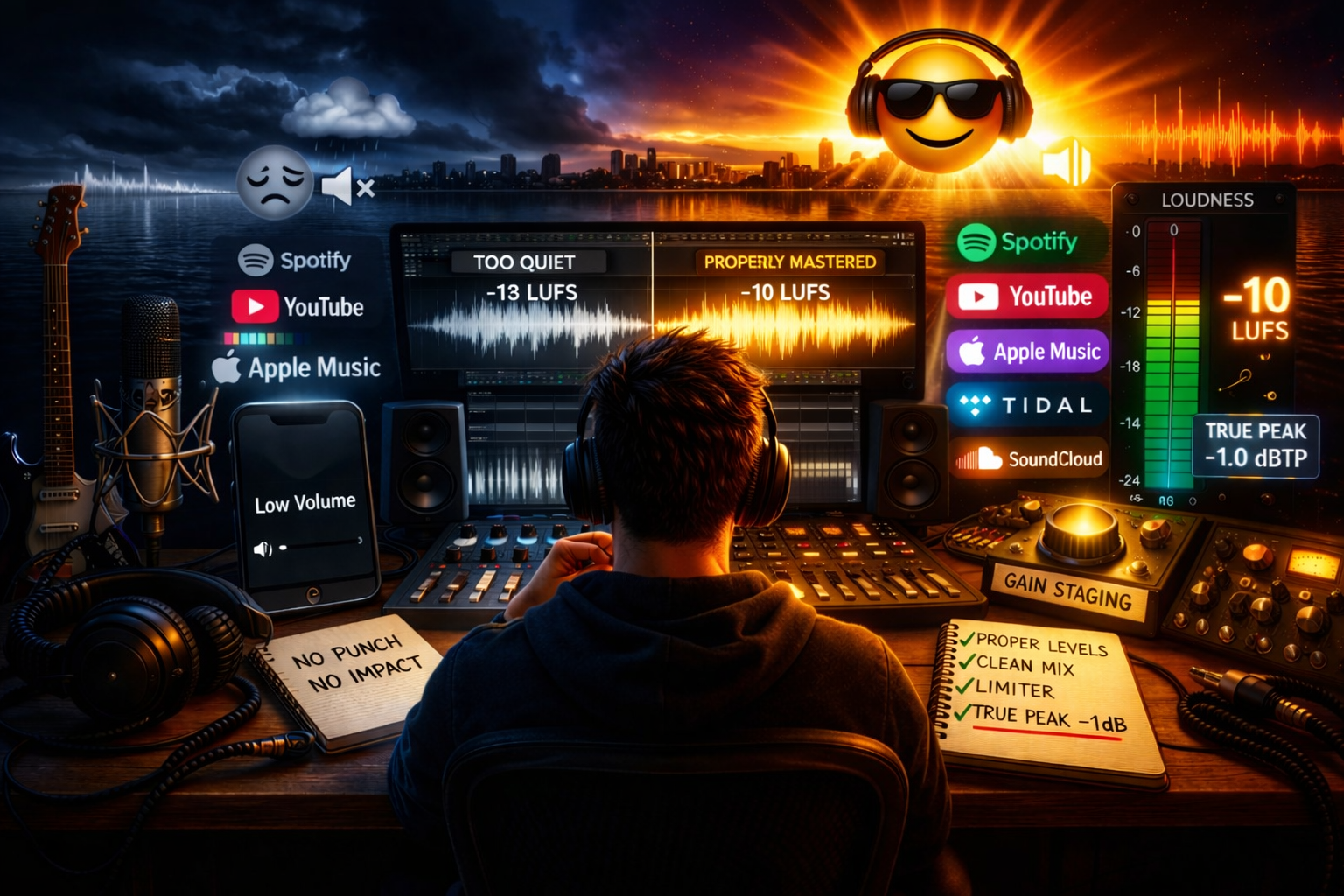
You finish a song, export it, listen back in the studio, and everything seems fine. It has energy, it feels solid, and it does not sound like it is falling short.
Then you upload it to Spotify, YouTube, Apple Music, TIDAL, or SoundCloud, compare it to other releases, and something changes. Your track suddenly feels smaller, less present, and lighter than it did in your session.
That happens to a lot of people, and it is usually misunderstood. The first reaction is to assume the song needs more volume. The second is to push the limiter harder. In many cases, neither of those things solves the problem. They just make the master tighter and less alive.
It is not only about volume
Once a song leaves your session and enters a streaming platform, it no longer lives in the same context in which you finished it. The file goes through encoding, different playback systems, and sometimes loudness normalization.
That is why a track that feels big in the studio can feel smaller outside it. Not necessarily because it is wrong, but because real playback changes the way balance, energy, and density are perceived.
Why other songs seem louder
The real difference is usually not that they simply “have more volume.” What often feels like a bigger song comes from something else: a stronger mix, better low-end control, more useful density, transients that survive, and a smarter balance between energy and dynamics.
In a lot of modern music, a master that translates well on streaming often lands closer to -11 to -9 LUFS integrated than to the old -14 myth. That range is far more realistic for a lot of current material, as long as the mix can support it and the master keeps its clarity.
That does not mean every song should go there. It means something simpler: the number alone does not decide whether a song feels big. The way it is built does.
The problem with chasing a number
For years, people kept repeating the idea that you had to master to a fixed streaming target. In practice, that usually creates two mistakes.
The first is leaving the song too low just to obey a number. The second is pushing it too hard out of anxiety, as if every extra dB would automatically bring more punch.
Neither of those things guarantees a better result. A master that is too soft can feel smaller than it should. A master that is too squeezed can lose impact even if the loudness meter shows a bigger number.
That is why it makes more sense to think about it this way: going louder than -9 LUFS is already a lot for one general stereo master. It can work in specific cases, especially in dense material that is very well built, but it stops being a broad recommendation and starts depending heavily on the mix, the arrangement, and the aesthetic of the song.
So what loudness range actually makes sense?
If you want a practical answer, this is a good starting point:
- -13 to -11 LUFS: a healthy range for a lot of music
- -11 to -9 LUFS: a common range in plenty of modern material when the mix is properly built
- Louder than -9 LUFS: possible in specific situations, but usually no longer the best general recommendation
If I had to reduce it to one idea, I would say this: for a well-built modern song, -11 to -9 LUFS is a much more realistic working range than the automatic -14 recipe.
And there is another equally important point: punch does not come from endlessly adding loudness. After a certain point, more level tends to bring more fatigue, more density, and less air, but not necessarily more impact.
True peak still matters
Even though many people obsess over LUFS, true peak is still a key part of real-world translation. A file that arrives too close to the ceiling can react worse once it gets encoded and played back outside the studio.
That is why even if the master is fairly strong, it still makes sense to leave true peak near -1 dBTP as a starting point. If the track is already quite tight, being even more conservative can help.
The real problem usually starts before mastering
When a song sounds quieter on streaming, it is often not because it “needs more LUFS.” What it usually needs is a mix with more space, better balance, and better control of energy.
If the low end is messy, if the buses are already overloaded, if compression keeps stacking up, or if the mix reaches mastering already flattened, the limiter is not going to fix the problem. Most of the time it will only make that problem more obvious.
That explains why two songs with similar numbers can behave in completely different ways on Spotify, YouTube, Apple Music, TIDAL, or SoundCloud. One keeps its impact. The other only keeps its level.
A better way to think about mastering for streaming
The most useful shift is to stop asking, “What LUFS number do I need to hit?” and start asking something else: how far can this song go without losing what makes it work?
That question puts everything in the right order. A ballad does not need to react the same way as a dense urban track. A production loaded with mids and low end cannot take the same treatment as a more open arrangement. And one well-mixed song can feel bigger at -10.5 than another one that was destroyed at -8.5.
In other words, the number alone is not in charge. The song is.
Conclusion
Your song does not sound quieter simply because Spotify or YouTube turned it down. It sounds quieter when the master depends too much on raw volume and not enough on the mix, on useful density, on balance, and on real control of the file.
If you want one simple guideline to remember, I would keep this: for streaming, a realistic and useful range for a lot of modern music sits between -11 and -9 LUFS, with true peak near -1 dBTP. Louder than that can work, but it is no longer a broad recommendation. And from that point on, punch usually does not come from adding more loudness, but from how the song is built.
That leads directly to the part that changes the result the most: gain staging. A lot of loudness problems are being discussed too late, when the real issue started much earlier in the way the mix was built from the beginning.
That deserves its own article, and that is exactly where the next step goes.
At se7en beatlab, we work on mixing, mastering, and technical decisions built for real-world translation, not just louder numbers on a meter.